ACL INJURY RATES
The anterior cruciate ligament (ACL)is one of the most commonly injured ligaments in the knee. Approximately 150,000 ACL injuries occur in the United States each year. Female athletes participating
in basketball and soccer are two to eight times more likely to suffer an ACL injury compared to their male counterparts. Recent data from the Women’s National Basketball Association indicates white European-American players may be at increased risk for ACL injury compared with African-American, Hispanic or Asian players. Athletes who have suffered an ACL injury are at increased risk of developing
arthritis later on in life, even if they have surgery for the injury. ACL injuries account for a large health care cost estimated to be over half-billion dollars each year.
WHY DO ACL INJURIES OCCUR?
Researchers believe there are external and internal factors associated with ACL injury. External factors include any play where the injured athlete’s coordination is disrupted just prior to landing or slowing down (deceleration). Examples of a disruption include being bumped by another player, landing in a pothole, or a ball deflection. Other external factors which have been studied include the effect(s) of wearing a brace, shoe-surface interface (how certain types of athletic footwear perform on different surfaces), and the playing surface itself. Internal factors include differences
in the anatomy of men and women,increased hamstring flexibility, increased foot pronation (flat-footed), hormonal effects, and variations in the nerves and muscles which control the position
of the knee. Anatomical differences between men and women, such as a wider pelvis and a tendency towards “knock knee” in women, may predispose women to ACL injury. Differences in ACL injury rates between men and women seem to begin shortly after puberty because the nerve/muscle system (coordination) adapts at a slower pace than the anatomical and hormonal changes. It is possible that the incidence of injuries in women increases at this age because the nerve/muscle system (coordination) adapts to these changes at a slower rate than in men. Women also tend to have knees that are less
stiff than men, placing more forces on the ligaments. In addition, the female hormone estrogen may relax or allow stretching of the ACL, thereby predisposing female athletes to ACL injury. Nerve/muscle factors pertain to the interaction and control of the knee by the quadriceps and hamstrings muscles in the legs. Researchers are very interested in studying this particular factor since it may be the easiest to modify.
HOW DO ACL INJURIES OCCUR?
Careful study of videos of athletes tearing an ACL show that approximately 70 percent of these injuries are noncontact and 30 percent occur during contact. The noncontact injuries usually occur during landing or sharp deceleration. In these cases, the knee at the time of injury is almost straight and may be associated with valgus (inward) collapse (see Figure 1). The athlete often lands with a flat-foot position and the leg is placed in front or to the side of the trunk.
PREVENTION OF ACL INJURY
Several prevention programs have been developed in an attempt to decrease the incidence of noncontact ACL injuries. The focus of current prevention programs is on proper nerve/muscle control of the knee. These programs focus on plyometrics, balance, and strengthening/stability exercises. Plyometrics is a rapid, powerful movement which first lengthens a muscle (eccentric phase) then shortens it
(concentric phase). The length-shortening cycle increases muscular power. An example would be an athlete jumping off a small box and immediately jumping back into the air after contact with the floor.
Balance training commonly involves use of wobble or balance boards. On-field balance exercises may include throwing a ball with a partner while balancing on one leg. To improve single-leg core strength
and stability, athletes perform exercises such as jumping and landing on one leg with the knee flexed and then momentarily holding that position.
PLYOMETRIC EXERCISES
High-intensity plyometrics may be key in reducing the number of ACL injuries. To be most successful, plyometric training should be performed more than once per week for a minimum of six weeks. Athletes are taught proper landing techniques which emphasize landing on the balls of the foot with the knees flexed and the chest over the knees (see Figure 2). The athlete should receive feedback on proper knee position to prevent inward buckling. Many of the newer programs are being adapted by coaches as an integral part of warm-up during practice, such as jumping over a soccer ball and landing in the correct position.
Information obtained from the American Orthopaedic Society for Sports Medicine, 2008.
Showing posts with label ACL tears. Show all posts
Showing posts with label ACL tears. Show all posts
Monday, June 24, 2013

Monday, July 9, 2012
Hirsch Twins Story of ACL Reconstruction
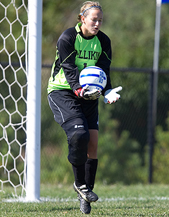 They may play different sports, but the Hirsch twins are, indeed, mirrors of each other. Active in basketball, softball and soccer for much of their childhood, Jennifer and Alayna Hirsch have undergone knee surgeries to treat ligament tears. Now, after some well-spent time helping each other recover and prepare for active sports seasons, both are in their senior year at Millikin University in Decatur, IL.
“We were anxious to play sports in our last year at college,” says Alayna. “I think we both worked hard to keep up with physical therapy and strengthening exercises so that we would be in good shape for the upcoming coming season.”
Alayna was the first to undergo surgery to reconstruct a torn anterior cruciate ligament (ACL) in her left knee that occurred while playing basketball at Parkway North High School in January, 2001. “I was a freshman point guard for the women’s basketball team and it was the end of a game when I went up for a lay-up. When I landed, I hyper-extended my knee and felt a pop,” says Alayna. “It was a very sharp pain. I let it rest for a couple of weeks and then tried to play in another game, but my knee gave out during warm-ups. My athletic trainer took one look and said I probably tore my ACL.”
The ACL is one of four major ligaments that stabilize the knee. In active individuals, especially those playing sports with rapid changes in direction such as soccer, baseball, hockey, football, or skiing, an ACL tear is one of the most common significant injuries to the knee.
“Once an ACL is torn, it cannot heal or repair itself,” says Rick Wright, MD, co-chief of sports medicine service with Washington University Orthopedics and team physician for the St. Louis Blues and St. Louis Rams. “We can improve range of motion and mobility with muscle-strengthening exercises to a small extent, but reconstructive surgery is the best option for those who want to regain an active lifestyle.”
Torn ACLs are reconstructed by taking strong, healthy tissue from either the patient’s patellar tendon (a strip of tendon underneath the kneecap) or a hamstring and surgically attaching the graft to the thighbone and shinbone. Donated cadaver tendons also can be used. The procedure restores stability.
Alayna underwent several months of physical therapy to get back in shape again to play high school sports. In a strange twist of fate, her sister Jennifer suffered the same injury and underwent ACL reconstruction later that fall.
“I was playing softball and twisted suddenly while throwing the ball in from the outfield,” she recalls. “I knew immediately that something was wrong.”
After four to six months of physical therapy, Jennifer also went back to an active schedule of high school sports. Both girls were later recruited by Milliken University to play multiple sports.
Fast forward to 2007. In what looked like a repeat of their earlier injuries, the Hirsch twins were again playing their favorite sports at Millikin — Jennifer playing soccer and Alayna on the softball team — when each tore the ACL in their opposite knees within two months of each other.
“Unfortunately, it’s not surprising that they injured their other knees,” says Dr. Wright, who has specialized in ACL reconstruction and other knee procedures for more than 13 years. “Research has shown that the opposite normal knee is just as likely to rupture after ACL reconstruction of the first knee. And women seem to be more prone to ACL tears than men.”
Dr. Wright is a principal investigator in the MultiCenter Orthopaedic Outcome Network (MOON) for ACL reconstruction. For the past several years, a national network of orthopedic surgeons in nine medical centers has been tracking ACL reconstruction patients to determine what risk factors lead to the development of a second ACL tear or the onset of osteoarthritis or decreased mobility in either knee. Investigators are also closely evaluating the differences in male and female anatomy to see how gender plays a role in the potential for ACL injuries.
“By following a large number of ACL patients in all of the medical centers involved, we hope to identify the variables that enable us to predict which patients are more likely to develop future injuries,” says Dr. Wright. “We can then evaluate treatment and therapy options to try to prevent those secondary injuries from occurring.”
Both Jennifer and Alayna Hirsch are enrolled in the MOON study and will be evaluated over the next 10 years to see how they continue to recover from their dual ACL reconstructions. For now, each is looking forward to an exciting senior year of sports at Millikin University and completing requirements for degrees in physical education and sports fitness.
“There’s always a little angst as I watch them get ready to play soccer or softball,” says the girls’ mom, Nancy. But they’re excited about their senior year and I’m glad to know that they are working on strengthening their legs and getting in shape again. “Playing sports is their passion and we’ve been fortunate to find great medical care for both of them.”
Friday, September 16, 2011
New Study Analyzes Second Surgery Implications for ACL Tears
A new study hopes to shed some light on why second surgeries for ACL tears carry a high risk for bad outcomes. Read more.
Subscribe to:
Posts (Atom)